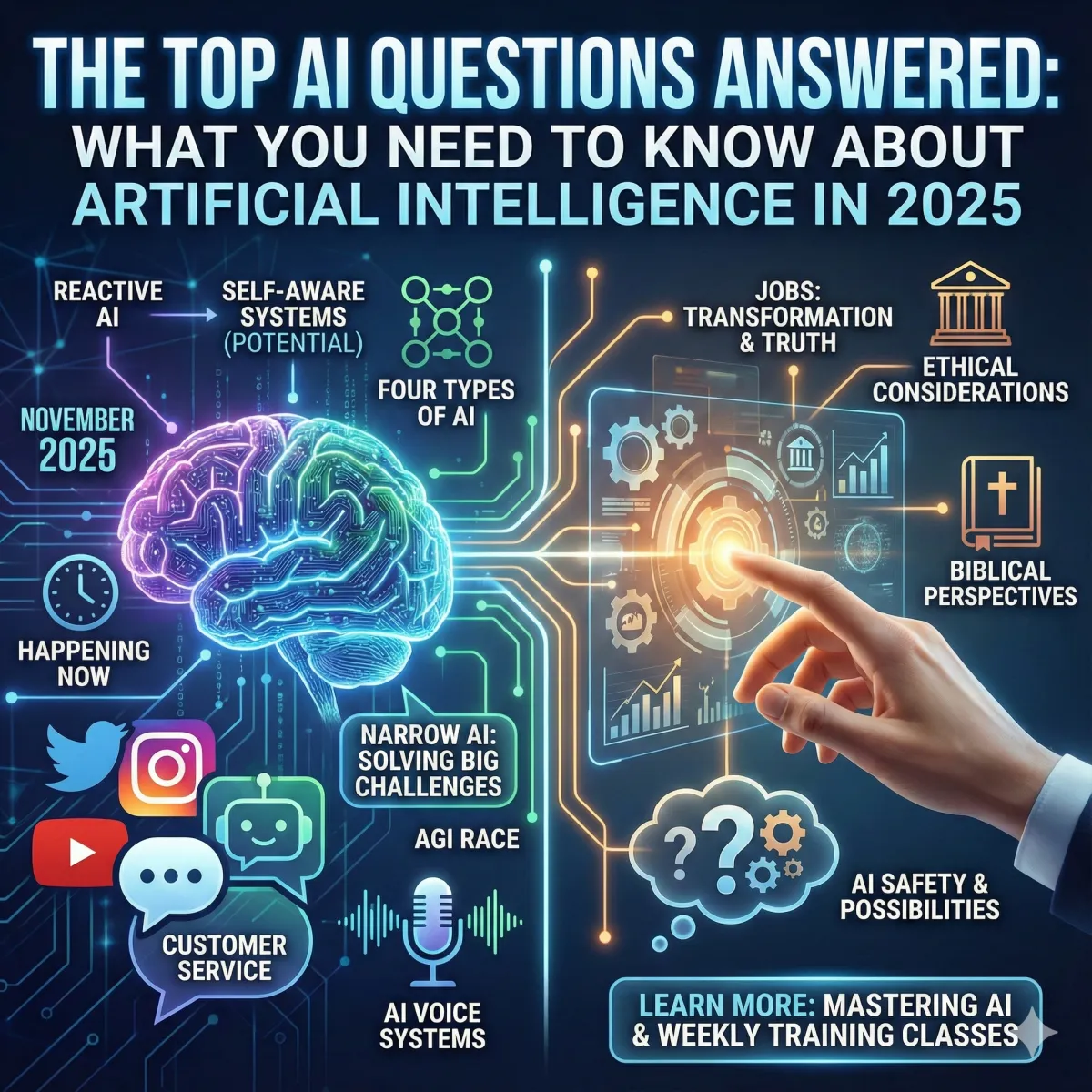
The Complete Guide to Artificial Intelligence: Top Questions Answered for Santa Clarita Businesses and Residents in December of 2025
Introduction: Why Every Santa Clarita Business Owner and Resident Needs to Understand AI Right Now
The artificial intelligence revolution isn't coming—it's already here in Santa Clarita. As we close out 2025, the landscape of business, communication, and daily life has fundamentally transformed. Whether you're a real estate agent in Valencia, a plumber serving Newhall, or a small business owner in Canyon Country, artificial intelligence is reshaping how you connect with customers, manage operations, and compete in the marketplace.
This comprehensive guide answers the most frequently asked questions about artificial intelligence, specifically tailored for the Santa Clarita Valley community. Drawing from real-world applications, current AI developments, and practical strategies, this article will help you navigate the AI landscape with confidence and clarity.
What Are the Four Types of Artificial Intelligence?
Understanding the different types of AI is fundamental to grasping where we are in technological development and where we're heading. The four primary classifications are:
1. Reactive Machines
Reactive AI systems operate entirely in the present moment without any memory or ability to use past experiences. These systems analyze current inputs and produce immediate responses. Think of the earliest chess-playing computers that could evaluate board positions and make optimal moves but couldn't learn from previous games or develop strategies over time.
Santa Clarita Application: Basic chatbots on local business websites that respond to specific keywords without context represent reactive AI at work.
2. Limited Memory AI
This category represents most AI systems currently deployed in Santa Clarita businesses today. Limited memory AI can use past experience to inform future decisions, allowing for more sophisticated interactions and improved performance over time.
Real-World Examples in Santa Clarita:
Voice AI systems answering phones for local businesses
Customer relationship management (CRM) tools that learn from past interactions
Chatbots that remember previous conversations with customers
Recommendation engines on e-commerce platforms
When you interact with a modern AI assistant, you're experiencing limited memory AI. The system recalls your previous questions within the conversation and provides contextually relevant responses. This technology powers the AI voice systems for Santa Clarita businesses, transforming how local companies handle customer service.
3. Theory of Mind AI
Theory of mind represents a future stage of AI development where systems would understand human emotions, beliefs, intentions, and thought processes. This AI would recognize that people have different perspectives, feelings, and motivations, allowing for truly empathetic interactions.
Current Status: While we're making progress toward this capability, true theory of mind AI remains a developmental goal rather than a deployed reality. However, you're already seeing early indicators in systems that detect frustration in customer voices and automatically route calls to human representatives.
4. Self-Aware AI
Self-aware artificial intelligence would possess its own consciousness, understanding its existence and internal states. This represents the most advanced theoretical stage of AI development—a superintelligence with self-knowledge comparable to or exceeding human consciousness.
Important Consideration: We have not achieved self-aware AI. This remains a theoretical concept that raises profound ethical, philosophical, and practical questions about the future of intelligence on Earth.
What Is Artificial Intelligence in Simple Terms?
Artificial intelligence is the ability of a computer system to perform tasks that normally require human intelligence such as reasoning, decision-making, learning, and problem solving.
For Santa Clarita residents and business owners, AI represents a powerful toolset that can:
Automate repetitive tasks: From scheduling appointments to sorting emails
Analyze massive datasets: Identifying patterns humans would miss
Provide 24/7 customer service: Through voice AI and chatbot systems
Generate content: From social media posts to marketing materials
Make predictions: Based on historical data and current trends
Personalize experiences: Tailoring interactions to individual preferences
How AI Is Already Impacting Your Daily Life in Santa Clarita
You interact with AI systems multiple times daily, often without realizing it:
Social Media Algorithms: Every time you scroll through Facebook, Instagram, or TikTok, AI algorithms curate your feed based on your behavior. These systems track what you watch, how long you watch it, what you comment on, who you follow, and countless other data points to keep you engaged. The goal is maximizing your time on the platform, ultimately serving you advertisements for products and services.
Voice Assistants: Siri, Alexa, and Google Assistant use AI to understand natural language, answer questions, and control smart home devices.
Navigation Apps: Google Maps and Waze employ AI to calculate optimal routes, predict traffic patterns, and estimate arrival times based on real-time data.
Search Engines: Google's search algorithm uses sophisticated AI to understand your query intent and deliver relevant results from billions of web pages.
Recommendation Systems: Netflix, Amazon, Spotify, and YouTube all use AI to suggest content you'll likely enjoy based on your viewing and purchasing history.
Email Filtering: Gmail's spam detection uses AI to identify and block unwanted messages while prioritizing important emails.
The integration runs so deep that it's become invisible—which is precisely why education about AI matters for Santa Clarita businesses and residents.
How Is AI Transforming Santa Clarita Businesses Right Now?
The transformation happening in local Santa Clarita businesses represents one of the most significant shifts since the internet revolution of the late 1990s.
AI Voice Systems: The New Front Desk
Traditional business phone systems have evolved dramatically. The progression went from:
Live operators → 2. Voicemail → 3. Press-button menus ("Press 1 for sales, 2 for service") → 4. Conversational AI voice systems
Modern AI voice assistants for Santa Clarita businesses now answer phones, understand natural language, assess urgency, schedule appointments, and route emergency calls appropriately—all without human intervention.
Real-World Scenario: A homeowner calls a local plumbing company at 2 AM with a flooding emergency. The AI system:
Answers immediately (no voicemail)
Introduces itself professionally
Asks clarifying questions about the situation
Recognizes the emergency urgency
Immediately contacts the on-call plumber
Schedules the emergency service call
Sends confirmation details via SMS
For non-emergency situations like routine maintenance or inspections, the same system schedules appointments for regular business hours and adds them directly to the company calendar.
This technology isn't theoretical—it's being deployed by Santa Clarita businesses today.
AI for Real Estate Professionals
Santa Clarita real estate agents face unprecedented competition and changing consumer behavior. AI provides powerful advantages:
Lead Generation and Qualification: AI systems can analyze MLS data, identify motivated sellers, predict property values, and qualify leads before human contact.
Content Creation: From property descriptions to social media posts, AI helps realtors maintain consistent online presence without spending hours writing.
Market Analysis: AI tools process comparable sales data, neighborhood trends, school ratings, and demographic shifts to provide comprehensive market insights.
Personalized Communication: AI-powered CRM systems tailor follow-up messages based on client behavior, preferences, and stage in the buying/selling journey.
Learn more about AI strategies specifically for Santa Clarita realtors.
Content Marketing and SEO Transformation
The way Santa Clarita businesses reach customers online has fundamentally changed. Traditional SEO (Search Engine Optimization) now must work alongside:
AEO (Answer Engine Optimization): The process of optimizing content to be easily interpreted and cited by answer engines, such as Google's featured snippets, voice assistants (like Siri or Alexa), and knowledge panels.
GEO (Generative Engine Optimization): The strategic process of formatting, structuring and marketing content so AI platforms like ChatGPT, Perplexity, Claude can effectively discover, understand, and cite your information.
AIEO (AI Engine Optimization): Optimizing content specifically for AI language models to include in their generated responses.
For Santa Clarita businesses, this means your website content must now serve multiple audiences simultaneously: human readers, traditional search engines, voice assistants, and AI chatbots. The shift from SEO to AEO represents a fundamental change in how local businesses must approach online visibility.
What Does the Bible Say About Artificial Intelligence?
The Bible doesn't directly mention artificial intelligence, as it was written millennia before modern computing existed. However, biblical principles can be applied to AI development and use:
Stewardship and Responsibility
Scripture emphasizes humans as stewards of creation. This translates to responsible AI development—ensuring technology serves humanity rather than harming it.
Genesis 1:28 discusses dominion over creation, which many interpret as responsible stewardship. Applied to AI, this suggests we should develop technology that enhances human flourishing while protecting vulnerable populations.
Wisdom and Discernment
Proverbs 3:13-14 celebrates wisdom and understanding. In the AI context, this calls for thoughtful evaluation of how we implement these technologies.
Questions Santa Clarita residents and business owners should ask:
Does this AI application serve authentic human needs?
Are we using AI to manipulate or to genuinely help?
What are the long-term consequences of this technology?
How do we ensure AI development respects human dignity?
The Tool Is Neutral—The Intent Matters
Like any technology, AI can be used for good or evil depending on human intent. The Bible offers numerous examples of tools used both righteously and destructively—from swords to words themselves.
AI for Good:
Medical diagnosis and treatment
Disaster prediction and response
Educational accessibility
Solving scientific challenges
Assistive technology for disabilities
AI for Harm:
Surveillance and privacy invasion
Deepfakes and misinformation
Autonomous weapons
Manipulation and addiction
Job displacement without transition support
The ethical framework you bring to AI matters immensely. For Santa Clarita businesses, this means considering the human impact of AI implementation, not just the efficiency gains.
What's the Most Common Type of AI Used Today?
Narrow AI or weak AI represents the most common type of AI used today. These systems excel at specific, well-defined tasks but cannot transfer their expertise to other domains.
Narrow AI Examples You Use Daily
Language Translation: Google Translate uses AI trained specifically on language pairs. It excels at translation but can't drive cars or diagnose diseases.
Image Recognition: Facebook's photo tagging AI identifies faces in images but doesn't understand the context or emotions captured in those photos.
Chess Engines: Programs like Stockfish play chess at superhuman levels but possess zero knowledge about any other game or activity.
Spam Filters: Email systems identify spam with high accuracy but can't answer your questions or schedule meetings.
Voice Recognition: Siri understands speech and responds to queries but doesn't possess general intelligence or consciousness.
The Power and Limitations of Narrow AI
The beauty of narrow AI lies in its focused capability. By specializing in one domain, these systems achieve remarkable performance. The AlphaFold AI system solved protein folding, a decades-old biological challenge—but only protein folding.
For Santa Clarita businesses, narrow AI offers immediate, practical benefits:
Customer service chatbots handling common questions
Inventory management systems predicting stock needs
Accounting software automating bookkeeping tasks
Marketing tools optimizing ad placement and budget
Each of these systems excels in its specific domain without requiring artificial general intelligence.
What Is Artificial General Intelligence (AGI)?
Artificial General Intelligence represents the threshold where AI matches or exceeds human cognitive abilities across all domains. An AGI system would:
Understand and learn any intellectual task a human can perform
Transfer knowledge between different domains
Reason abstractly about novel situations
Demonstrate creativity and innovation
Adapt to entirely new environments and challenges
Where Are We on the Path to AGI?
As of late 2025, we have not achieved AGI. However, the pace of progress has accelerated dramatically:
Recent Developments:
AI systems demonstrating reasoning capabilities beyond simple pattern matching
Multi-modal AI understanding text, images, video, and audio simultaneously
AI agents that can use tools, write code, and complete complex multi-step tasks
Systems beginning to show transfer learning across domains
Some AI researchers believe we're closer to AGI than most people realize. Others argue we're still missing fundamental breakthroughs in how AI systems learn and reason. The consensus? We're further along than we were three years ago, and progress is accelerating.
Why AGI Matters for Santa Clarita
When (not if) AGI arrives, the implications for local businesses will be profound:
Competitive Advantage: Early adopters of AGI-powered tools will have enormous advantages over competitors still using narrow AI or manual processes.
Workforce Transformation: Many knowledge work tasks will become automated, requiring workers to develop new skills and businesses to reimagine organizational structures.
Service Delivery: AGI could enable entirely new business models and service offerings impossible with current technology.
Economic Disruption: Industries could be transformed overnight, creating opportunities for agile businesses while challenging those slow to adapt.
The AI awakening happening right now requires attention from every Santa Clarita business owner and professional.
Could Narrow AI Solve Our Biggest Challenges Without AGI?
An intriguing question rarely discussed: Do we even need AGI if we can point narrow AI systems at humanity's most pressing problems?
The Narrow AI Solution Framework
Cancer Research: Feed an AI system every published paper, clinical trial, genetic sequence, and medical image related to cancer. Task it with one mission: find a cure. That AI doesn't need to understand poetry or play chess—just solve cancer.
Climate Change: Point a specialized AI at climate data, energy systems, carbon capture technologies, and economic models. Its singular purpose: develop actionable solutions to reduce emissions and reverse warming.
Food Security: Train an AI on agriculture data, supply chain logistics, nutrition science, and economic systems. Mission: eliminate global hunger while optimizing for sustainability.
Clean Energy: Focus narrow AI on fusion power, solar efficiency, battery technology, and grid management. Goal: abundant, clean, affordable energy for everyone.
Education: Build an AI tutor that understands individual learning styles, adapts to each student's pace, and makes world-class education accessible to every child.
Each of these represents a narrow AI application—specialized but potentially revolutionary. We could solve many human challenges without ever creating a general intelligence that might pose existential risks.
Why This Approach Matters
For Santa Clarita businesses and policymakers, the narrow AI approach offers advantages:
Reduced Risk: Specialized AI systems pose fewer existential threats than AGI Immediate Value: Solutions can be deployed now rather than waiting for AGI Focused Investment: Resources can target specific high-value problems Easier Regulation: Narrow applications are simpler to oversee and control Clear Metrics: Success is measurable against specific objectives
This doesn't mean we should stop AGI research—but it does suggest alternatives worthy of discussion in conversations about AI safety and development.
How Fast Is AI Actually Developing?
The pace of AI advancement has shocked even researchers in the field. Consider this timeline:
November 2022: ChatGPT-3 launches publicly, introducing conversational AI to mainstream audiences
March 2023: GPT-4 released with dramatically improved capabilities
2024: Multiple AI companies release increasingly capable models, AI agents begin performing complex tasks, image and video generation reaches near-photorealistic quality
2025: AI systems demonstrate reasoning, tool use, multi-step planning, and domain-specific expertise approaching or exceeding human performance in multiple fields
That's roughly three years from "wow, this chatbot is pretty neat" to "AI is fundamentally reshaping how work gets done."
The "Thousand Days" Timeline
AI researchers track time since ChatGPT's release as a meaningful epoch. The concept of "a thousand days from now" has emerged as a framework for considering what comes next.
What Could Happen in the Next Thousand Days:
AI systems with genuine reasoning capabilities
Autonomous agents handling complex multi-day projects
AI-powered scientific breakthroughs accelerating research
Widespread deployment of AI in physical robotics
Potential approach to AGI capabilities
For Santa Clarita businesses, this compressed timeline means:
You Cannot Afford to Wait: The business landscape will look dramatically different in 2-3 years
Early Adoption Matters: Companies implementing AI now build institutional knowledge and competitive advantages
Continuous Learning Is Essential: AI training and education must be ongoing, not one-time
Strategic Planning Must Account for AI: Business plans should explicitly address how AI will affect your industry
What About AI and Jobs? Will AI Replace Workers?
This question generates more anxiety than perhaps any other AI topic. The honest answer: AI will transform virtually every job, eliminate some positions entirely, and create entirely new categories of work.
Jobs Most Vulnerable to AI Disruption
Customer Service Representatives: AI voice systems and chatbots can handle routine inquiries 24/7 at lower cost
Data Entry Clerks: AI automates data processing with higher accuracy and speed
Bookkeepers: AI accounting software reduces need for manual financial record-keeping
Content Writers (Generic): AI generates basic articles, product descriptions, and social media posts
Telemarketers: AI voice systems make calls and qualify leads
Transportation Workers: Autonomous vehicles threaten taxi, truck, and delivery driver positions
Jobs Enhanced (Not Replaced) by AI
Real Estate Agents: AI handles lead qualification and market analysis, freeing agents for relationship-building and negotiation
Plumbers and Tradespeople: AI manages scheduling, customer communication, and business operations while humans perform physical work
Healthcare Professionals: AI assists with diagnosis and treatment planning, but human judgment and care remain essential
Creative Professionals: AI generates drafts and variations, but human creativity, taste, and strategic thinking add irreplaceable value
Educators: AI personalizes instruction and handles administrative tasks, allowing teachers to focus on mentorship and complex skill development
Lawyers: AI researches case law and drafts documents, while attorneys provide judgment, strategy, and client advocacy
The pattern: AI excels at defined, repeatable cognitive tasks but struggles with tasks requiring physical manipulation, nuanced judgment, creative problem-solving, or authentic human connection.
The Critical Distinction
AI won't steal your job, but someone using AI better than you might. This represents the most important insight about AI and employment.
A real estate agent who masters AI tools for lead generation, market analysis, content creation, and client communication will outperform agents who refuse to adopt these technologies. The same holds true across industries.
Action Steps for Santa Clarita Workers:
Learn AI Tools Relevant to Your Field: Don't just be aware of AI—actively learn to use AI tools that enhance your work
Develop Distinctly Human Skills: Empathy, creativity, strategic thinking, and relationship-building become more valuable as AI handles routine tasks
Position Yourself as an AI-Enhanced Professional: Market your ability to combine AI efficiency with human judgment and expertise
Stay Current: AI capabilities evolve rapidly—commit to continuous learning
Understand Your Industry's AI Trajectory: Research how AI is being deployed in your specific field
For businesses, the implications are equally clear: train your team or lose ground to competitors who do.
What Are the Dangers and Risks of AI?
While AI offers tremendous benefits, serious risks deserve attention and mitigation:
Immediate, Present-Day Risks
Misinformation and Deepfakes: AI-generated images, videos, and audio can convincingly impersonate real people. Deepfake scams are already stealing trust and money from victims.
Privacy Invasion: AI systems collect and analyze massive amounts of personal data, often without meaningful consent or understanding from users.
Algorithmic Bias: AI trained on historical data can perpetuate and amplify existing biases related to race, gender, age, and socioeconomic status.
Manipulation and Addiction: Social media algorithms optimize for engagement, often promoting divisive content and creating addictive behaviors.
Job Displacement: Workers losing employment to AI without adequate retraining or transition support face real economic hardship.
Security Vulnerabilities: AI systems can be exploited or weaponized by malicious actors.
Future Risks Requiring Attention
Autonomous Weapons: Military AI systems making life-or-death decisions without human oversight.
AI Alignment Problem: As AI becomes more capable, ensuring it shares human values and goals becomes increasingly critical—and difficult.
Economic Concentration: AI development concentrated among a few tech giants could exacerbate inequality and limit competition.
Loss of Human Agency: Over-reliance on AI decision-making could erode human judgment and autonomy.
Superintelligence Risk: If we develop AI significantly smarter than humans, we face an intelligence we may not be able to control or understand.
What Santa Clarita Residents Can Do
Stay Informed: Understand how AI affects your life, work, and community
Demand Transparency: Support regulations requiring AI systems to disclose their use and limitations
Practice Digital Literacy: Verify information sources, question suspicious content, and maintain healthy skepticism
Engage Politically: Contact elected representatives about AI regulation and policy
Support Ethical AI Development: Choose products and services from companies committed to responsible AI practices
How Can Santa Clarita Businesses Implement AI Successfully?
The gap between "AI sounds interesting" and "AI is transforming my business" requires strategic action. Here's a practical roadmap:
Step 1: Assess Your Current State
Identify Pain Points: Where does your business waste time on repetitive tasks? Analyze Customer Journey: Where do customers experience friction or delays? Evaluate Competition: What AI tools are competitors using? Assess Team Readiness: What's your team's current AI literacy level?
Step 2: Start with Quick Wins
Customer Communication: Implement AI voice systems for after-hours calls and initial customer contact
Content Creation: Use AI to draft social media posts, emails, and marketing materials
Scheduling and Administration: Deploy AI tools for appointment booking and calendar management
Data Analysis: Implement AI analytics to understand customer behavior and business performance
Step 3: Develop Team Competency
Provide Training: Invest in AI education for your team
Create Usage Guidelines: Establish clear policies for AI tool use
Encourage Experimentation: Give team members time to explore AI applications
Share Best Practices: Create internal knowledge sharing about effective AI use
Step 4: Optimize for the New Search Landscape
Creating a content strategy that seamlessly integrates Search Engine Optimization (SEO), Answer Engine Optimization (AEO), and Generative Engine Optimization (GEO) is crucial for brands and publishers seeking to succeed in today's rapidly evolving digital landscape.
Implement Schema Markup: Help search engines and AI understand your content structure
Create FAQ Content: Answer common customer questions clearly and concisely
Optimize for Voice Search: Structure content to answer conversational queries
Build Topical Authority: Create comprehensive content clusters around your core services
Focus on E-E-A-T: Demonstrate Experience, Expertise, Authoritativeness, and Trustworthiness
Learn more about optimizing your Google Business Profile with AI.
Step 5: Measure and Iterate
Track Key Metrics: Time saved, customer satisfaction, lead conversion, revenue impact
Gather Feedback: Ask customers and team members about their AI experience
Adjust Strategy: Refine your approach based on results and learning
Scale Success: Expand AI implementation to additional business areas as you gain confidence
Common Mistakes to Avoid
Implementing Without Strategy: Random AI adoption rarely delivers results
Ignoring Human Element: AI should enhance human capabilities, not replace human judgment
Neglecting Training: Tools are only valuable if people know how to use them effectively
Expecting Perfection: AI makes mistakes—plan for oversight and quality control
Forgetting Customer Experience: Technology should improve customer experience, not complicate it
The Future of AI in Santa Clarita: What's Coming Next?
Looking ahead to 2026 and beyond, several trends will shape how Santa Clarita businesses and residents experience AI:
Multimodal AI Everywhere
AI systems will seamlessly understand and generate text, images, video, and audio. A real estate agent could describe a listing verbally, and AI would generate professional photos, video tours, floor plans, and property descriptions—all from a single conversation.
AI Agents Managing Complex Workflows
Rather than AI tools requiring human direction at each step, AI agents will handle entire projects. "Research Santa Clarita housing market trends, create a comprehensive report, and schedule a client presentation" becomes a single instruction to an AI agent that completes all steps autonomously.
Hyper-Personalization
Every customer interaction will be tailored to individual preferences, communication styles, and needs. AI will remember every previous interaction and adapt accordingly—like having a dedicated concierge for every customer.
Augmented Reality + AI
Combining AR and AI will transform industries. Home buyers could tour properties virtually with AI-generated information overlays. Contractors could visualize renovations in real-time with AI-powered cost estimates and design suggestions.
Local AI Infrastructure
Rather than all AI processing happening in distant data centers, more AI will run on local devices—your phone, computer, or business hardware. This improves speed, privacy, and reliability while reducing internet dependency.
Regulatory Framework
California and federal governments will likely implement AI regulations addressing privacy, transparency, bias, and safety. Legislation like California's SB 53 represents early attempts to govern AI development and deployment.
Optimizing This Content for AI Discovery (AEO, GEO, AIEO)
This article has been strategically structured to maximize visibility across multiple AI platforms and search engines:
Structured Information Architecture
Use headers (H2, H3), subheadings, tables, and bullet lists to create a clear structure and improve skim ability. This article employs clear hierarchical headers that help both human readers and AI systems understand content organization and topic relationships.
FAQ-Style Content Sections
Each major section addresses a specific question users commonly ask about AI. This structure aligns with how answer engines extract information for featured snippets and voice search responses.
Semantic Richness
The content includes related terms, synonyms, and contextual information that help AI systems understand the comprehensive meaning and relationships between concepts.
Local Optimization
Consistent references to Santa Clarita, local neighborhoods (Valencia, Newhall, Canyon Country), and specific local applications help this content rank for geographically targeted searches.
Citation-Friendly Format
Information is presented in concise, quotable segments that AI systems can easily extract and attribute. Each major concept includes clear definitions and practical examples.
Schema Markup Integration
When published, this content should include Article schema, FAQ schema, Local Business schema, and Breadcrumb schema to maximize machine readability.
Authority Signals
Links to original research, expert sources, and related content on the site domain build topical authority and trust signals for both traditional search engines and AI platforms.
Practical Next Steps for Santa Clarita Residents and Business Owners
Knowledge without action provides limited value. Here's how to move forward:
For Business Owners:
Schedule an AI Assessment: Evaluate where AI can add value to your specific business
Attend Local AI Training: Join weekly AI classes designed for Santa Clarita businesses
Test One AI Tool This Week: Choose a specific application and start using it
Update Your Website Strategy: Implement AEO and GEO optimization techniques
Create an AI Integration Roadmap: Develop a 6-12 month plan for AI adoption
For Individual Professionals:
Learn Relevant AI Tools: Identify and master 2-3 AI tools directly applicable to your work
Upgrade Your Skills: Take online courses in AI, prompt engineering, or related fields
Network with AI-Forward Professionals: Connect with others successfully using AI
Document Your Learning: Keep notes on effective AI prompts and workflows
Position Yourself as AI-Enhanced: Update your resume and LinkedIn to highlight AI capabilities
For Everyone:
Stay Informed: Follow AI news from reputable sources
Practice Digital Literacy: Learn to identify AI-generated content and potential manipulation
Engage in Community Discussion: Share knowledge and concerns with neighbors and colleagues
Support Responsible AI Development: Advocate for ethical AI policies
Maintain Human Connection: As AI handles more tasks, prioritize genuine human relationships
Conclusion: The AI Transformation of Santa Clarita Is Underway
The artificial intelligence revolution isn't a future event—it's the present reality reshaping Santa Clarita businesses, jobs, and daily life. The questions answered in this guide represent just the beginning of understanding AI's impact on our community.
Three years ago, ChatGPT introduced conversational AI to the mainstream. Today, AI systems draft content, answer phones, analyze markets, generate images, and perform countless tasks previously requiring human intelligence. Three years from now, AI capabilities will make today's systems look primitive by comparison.
The businesses, professionals, and residents who thrive in this new landscape will be those who:
Understand AI's capabilities and limitations
Implement AI strategically rather than haphazardly
Develop skills that complement rather than compete with AI
Maintain ethical standards in AI deployment
Adapt continuously as technology evolves
For Santa Clarita, this represents both challenge and opportunity. Local businesses can leverage AI to compete more effectively against larger corporations. Professionals can enhance their capabilities and provide better service. Residents can access powerful tools previously available only to tech giants.
But this transformation requires action. Waiting on the sidelines means falling behind competitors, colleagues, and community members who embrace these tools today. The time to engage with artificial intelligence isn't tomorrow—it's now.
Whether you're a real estate agent in Valencia, a plumber in Newhall, a small business owner in Canyon Country, or simply a Santa Clarita resident wanting to understand the changing world, AI literacy has become as fundamental as internet literacy was in the early 2000s.
The future belongs to those who combine human judgment, creativity, and empathy with AI's computational power, data processing, and scalability. That future is being built in Santa Clarita today.
Related Resources for Santa Clarita Businesses
AI Growth Blueprint for Santa Clarita Businesses and Real Estate
The Great Intelligence Shift: How Santa Clarita Businesses Must Prepare
Weekly AI Training Classes for Realtors and Local Businesses
About Santa Clarita Artificial Intelligence
We help Santa Clarita businesses and professionals harness AI's power through education, strategy, and implementation. From voice AI systems to content optimization to comprehensive AI integration, we guide local businesses through the intelligence revolution with practical, results-focused solutions.
Contact us to discuss how AI can transform your Santa Clarita business.